

OCD ingwon reflects on our original MVP theses and docs
learnings and musings, 150 days into building ember

it’s now day ~150 of my brother and i building/bootstrapping an app from scratch and so here’s an update on my learnings & musings so far.
one of my goals in posting this is to process, reflect, and articulate. the other goal is that by going through this reflection, i can hopefully learn some good lessons.
in it… i try to be unflinchingly honest, for better or for worse :)
quick recap: our initial goals, assumptions, and thought process
i thought it’d be interesting to start with the original MVP doc we wrote before building the app (Day 0)…
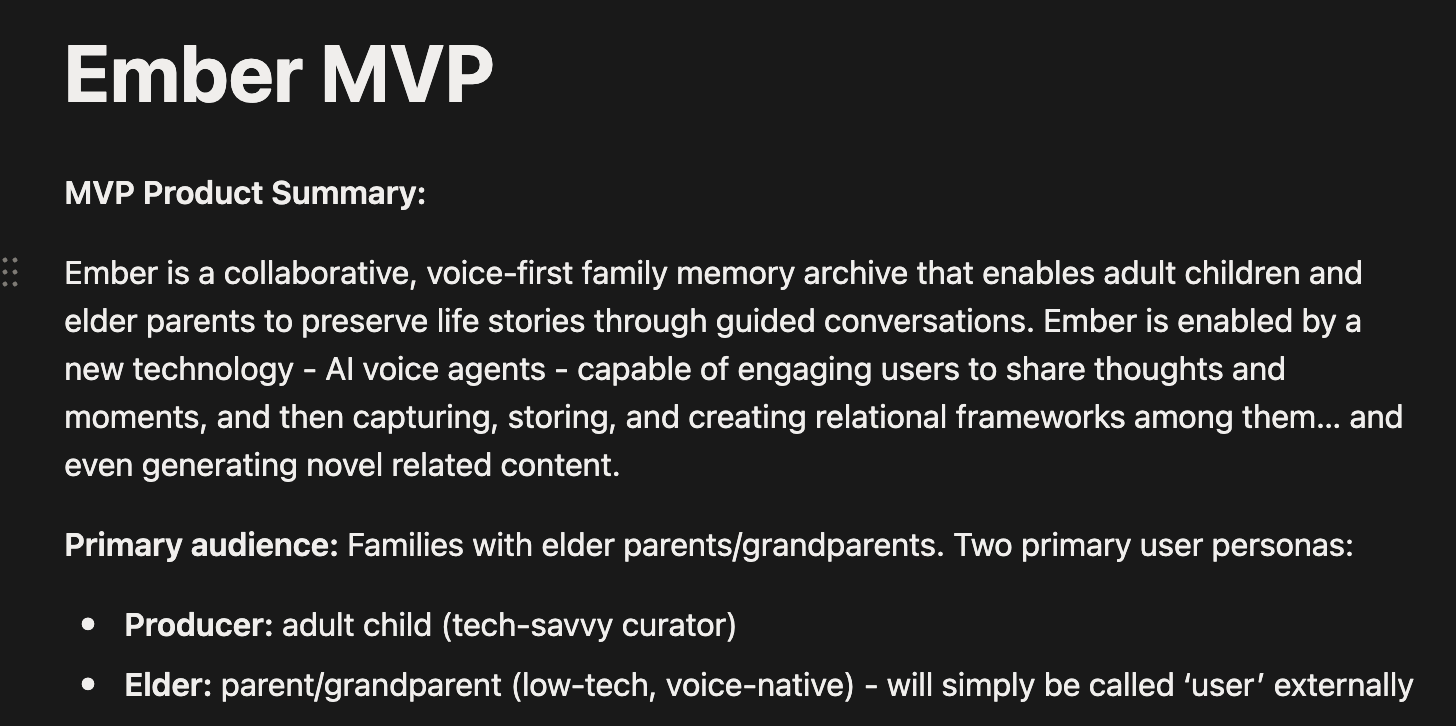
here’s the MVP Product Summary:
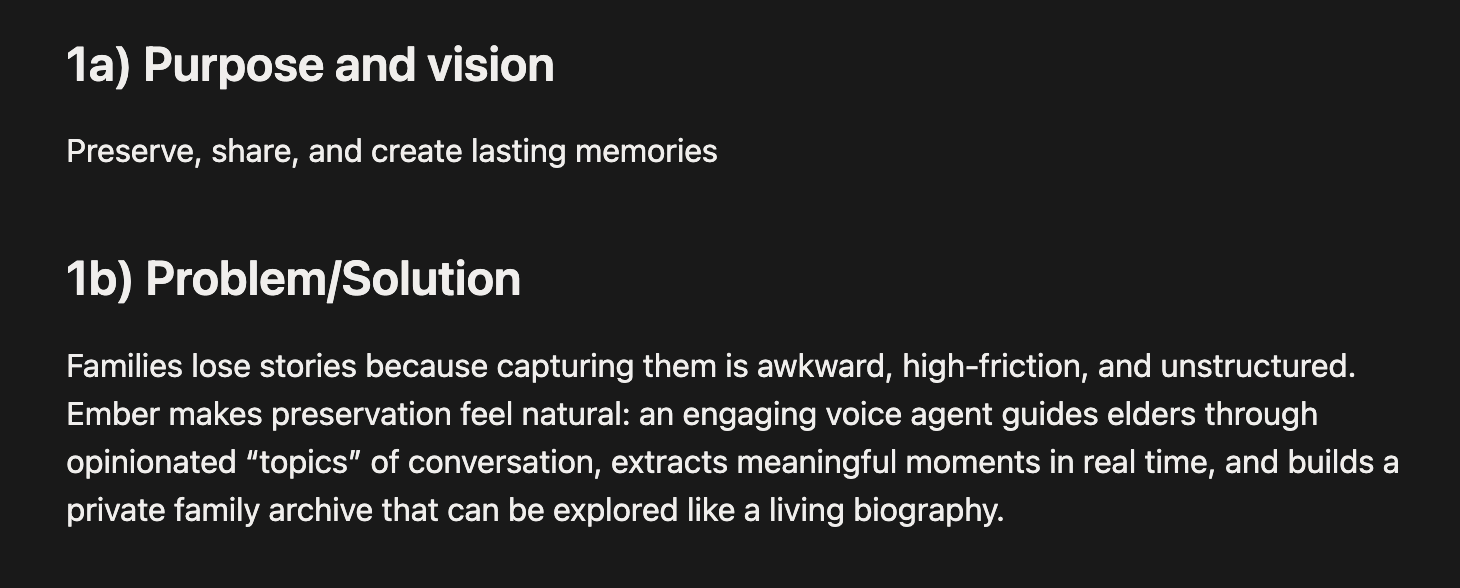
here’s our statement about purpose and vision, and the problem/solution:
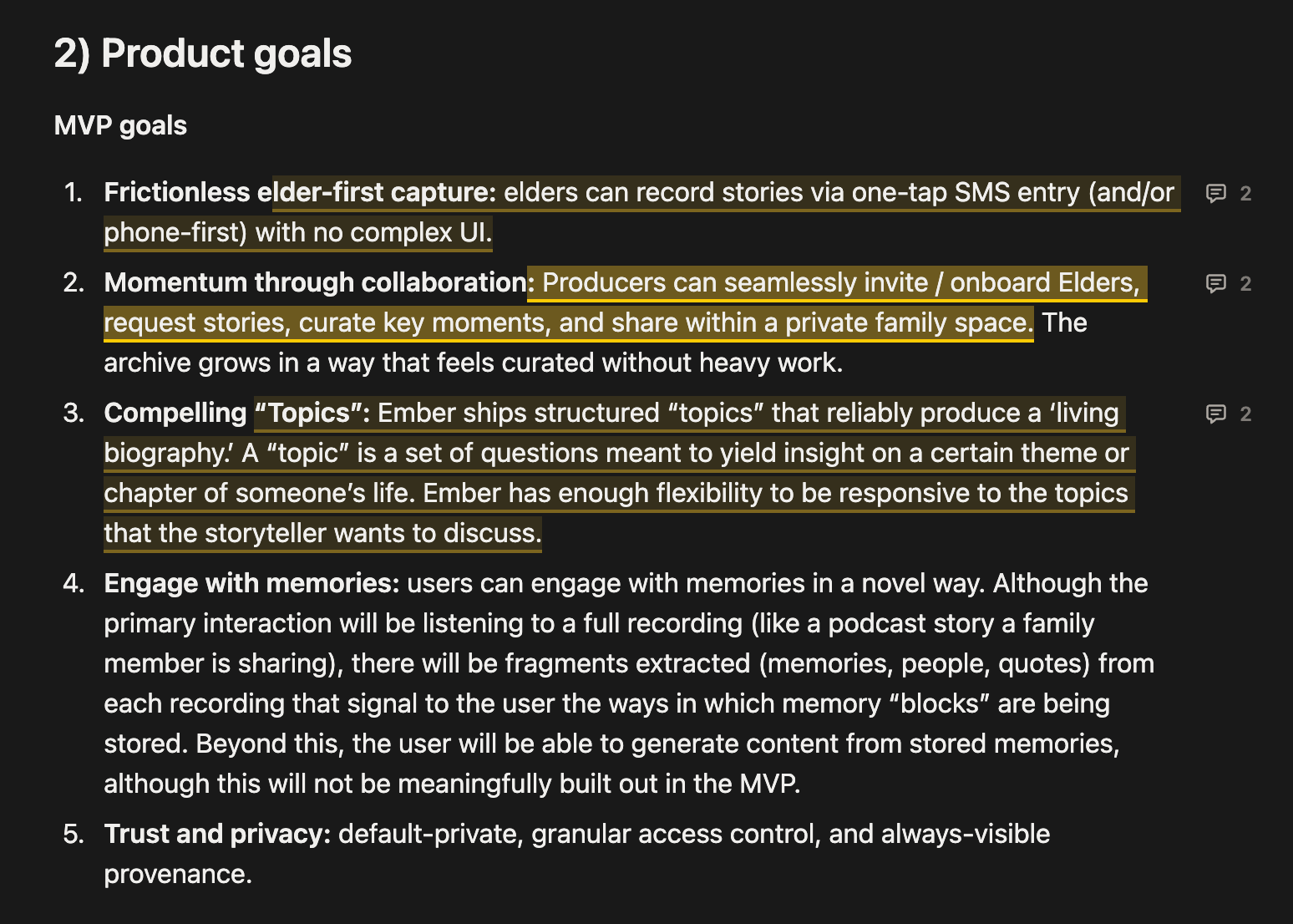
here’s our product goals:
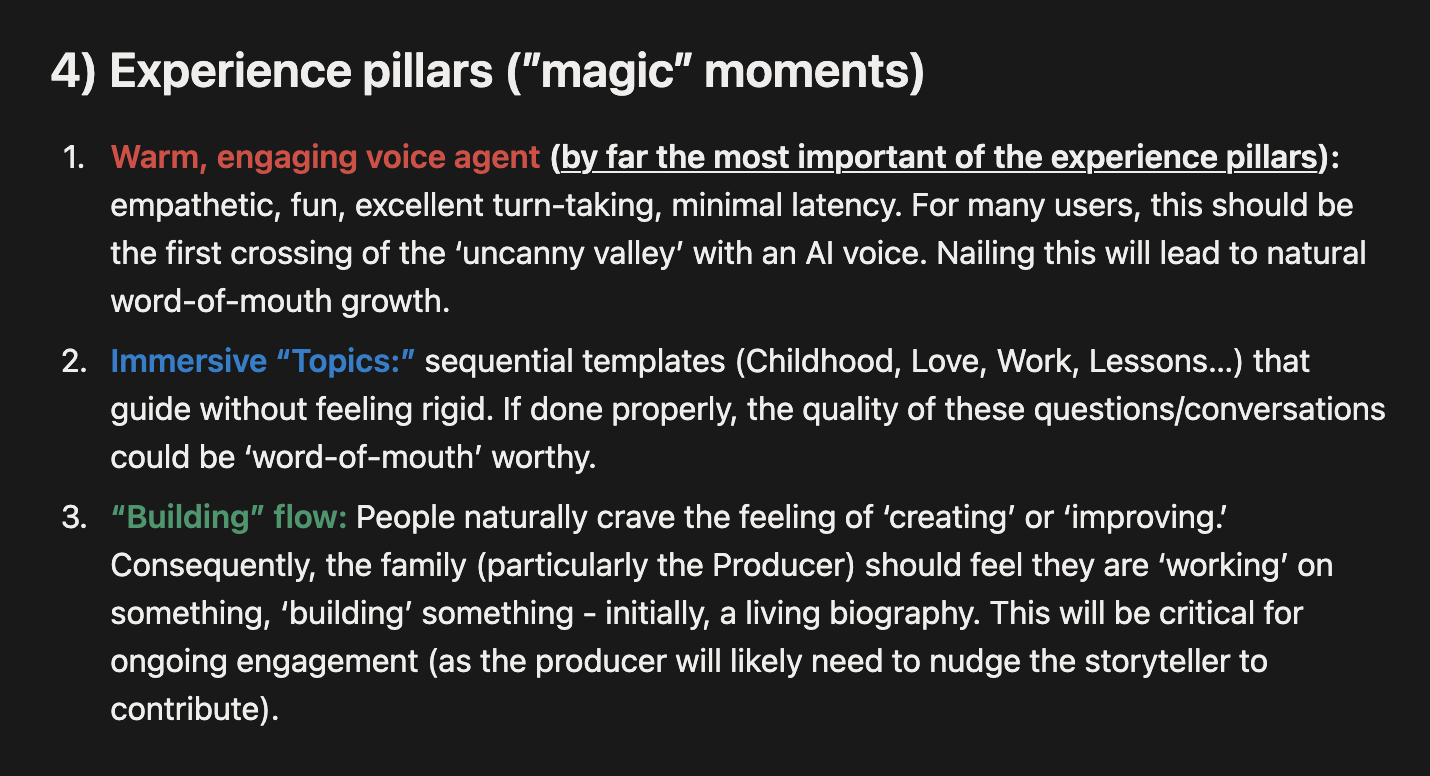
and here’s what we thought our MVP “magic” moments would be:
how the cake turned out when we took it out of the oven
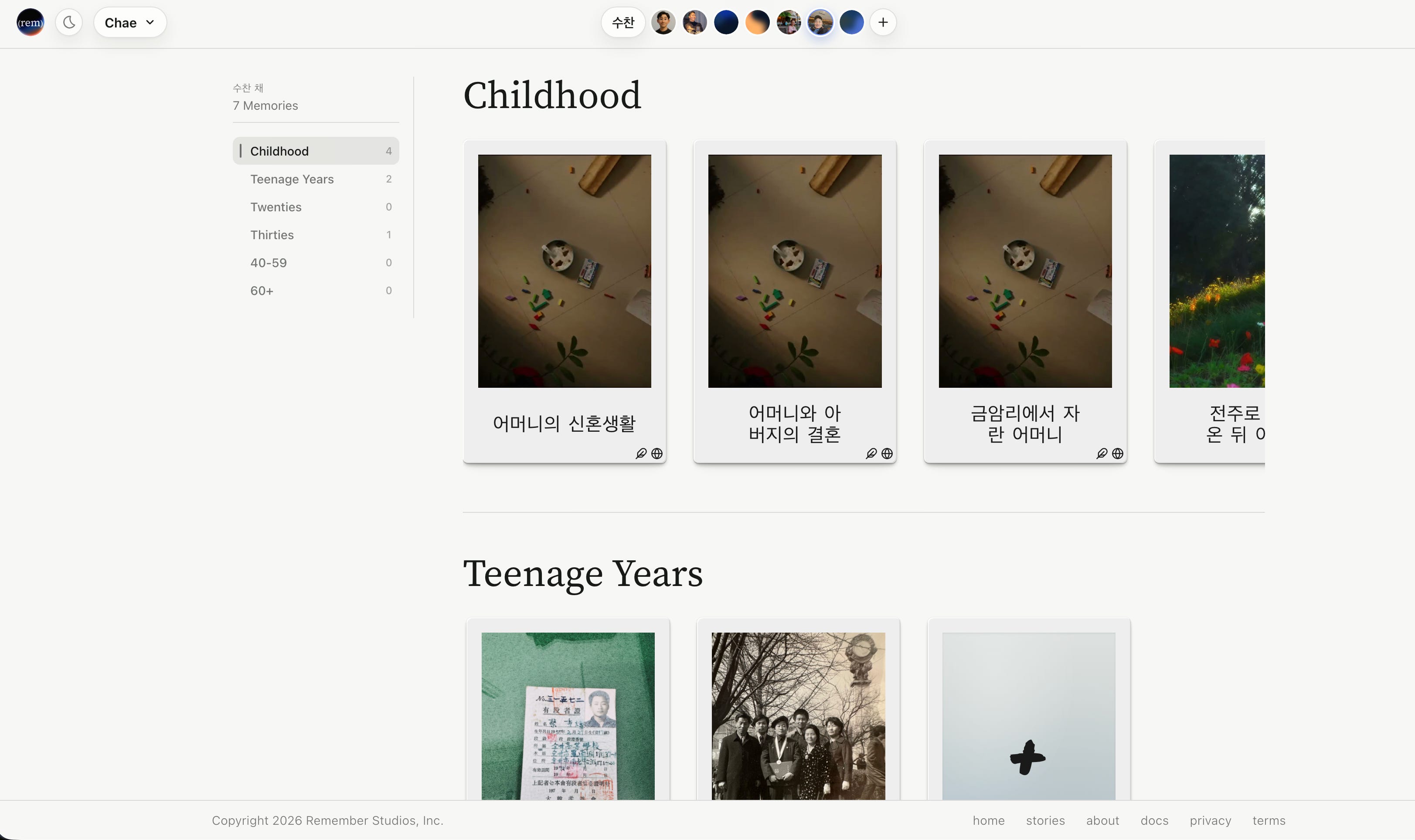
so drumroll… how’d the cake turn out? well, we have a functioning web app that works in 8 languages. users can have a conversation with a voice AI agent about ~40 different topics we painstakingly hand created, and can invite other users to be able to access and listen to those conversations. below shows a “feed” of my dad’s recordings, all in korean (his native language)…
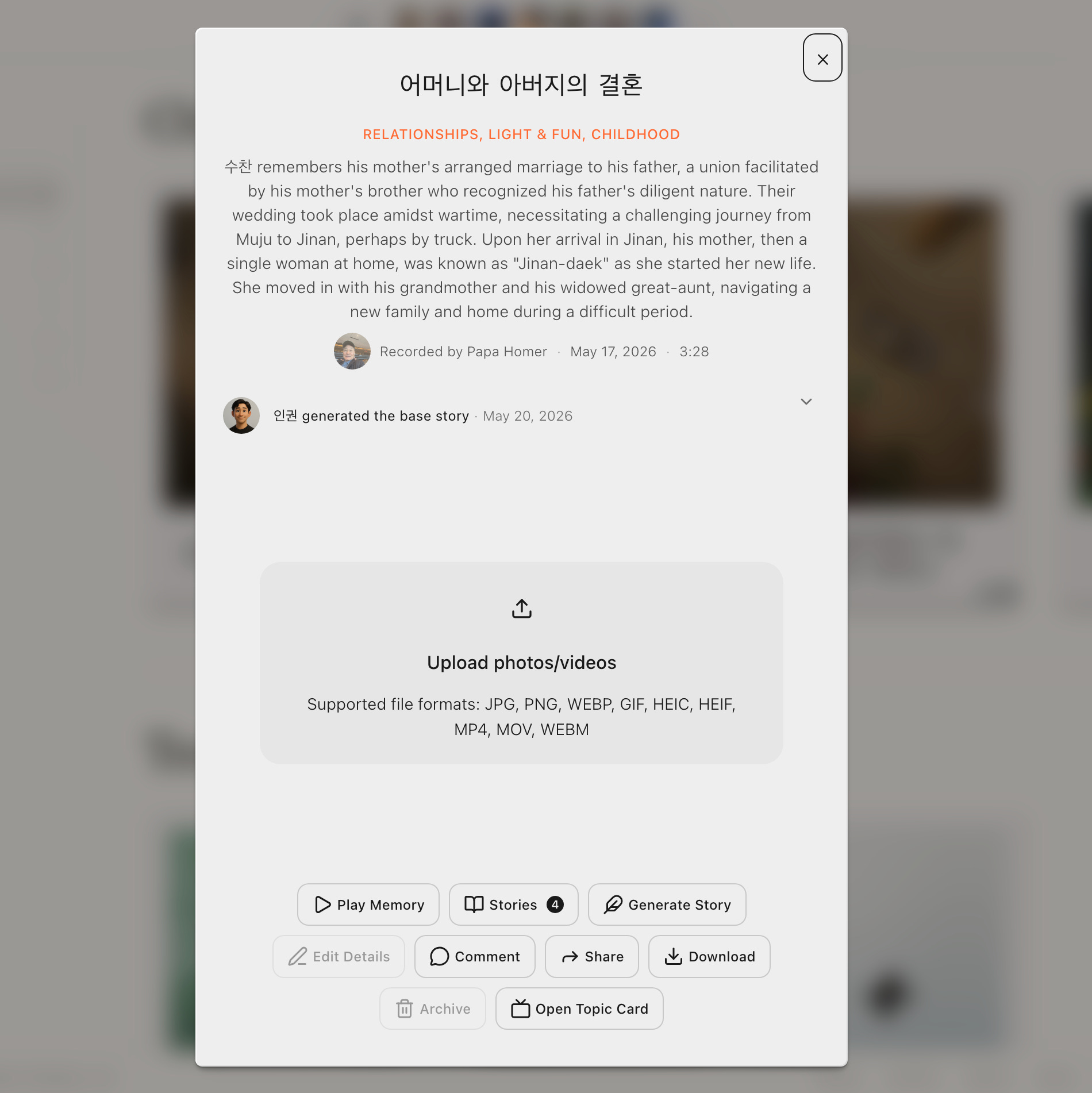
and, since (even though I can speak and understand korean reasonably well) my native language is english, the app generates conversation summaries in each user’s own preferred language…
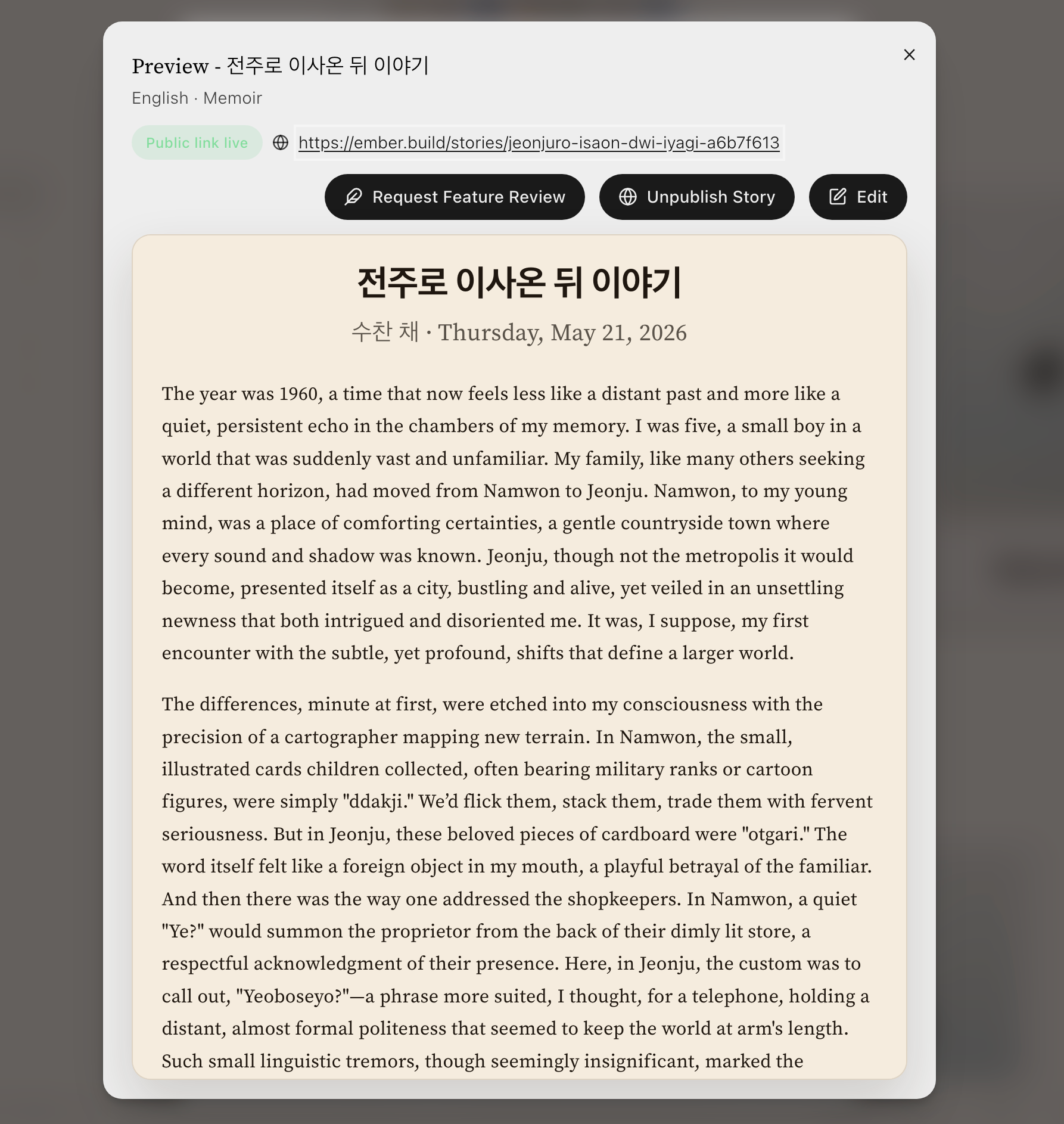
and below is what we thought would be our “magic moment”: users can generate literary memoirs, poems, short stories, or biographical chapters from these voice conversations with the click of a button, and publish them. you can see some real examples of published stories at https://ember.build/stories …
the results so far on the journey to PMF🥁
with minimal marketing (mostly friends & fam), we had ~100 signups … and 1 retained enthusiastic user (our dad). oh, and we hired ~5 summer interns to help us figure out marketing 😅. sigh…
some observations i have about our process that took us to this point and a few thoughts on those. honestly all of these are pretty stereotypical first time founder mistakes. but on the bright side, we did manage to push the ship (a MVP) out of harbor, so no need to lose too much sleep:
we didn’t validate or spend time talking to users or customers before building the MVP. the PRD above was written without a single formal user interview where we ran the PRD by them. in retrospect, i wish we’d first had a few focused, but open-ended discovery conversations with potential users. just finding people who find the intersection of memory, personal stories, and AI would have been incredibly valuable in helping us better understand what kind of things they’d want built (as opposed to what we think people want).
we didn’t bother with an exercise in defining a user persona. for example: our first N customers will be 50-70 year old semi-affluent parents of children in their 30s who have just recently been diagnosed with terminal cancer. ok, dark, i know… but also like, really specific, and… maybe a reasonable hypothesis on who might have the urgency to want to immediately use the app? being able to articulate our ideal user persona so clearly would provide extreme clarity on how exactly to go find those N customers (extremely specific instagram posts, loitering in radiology wards of local hospitals), and clarify our messaging.
we spent too long (2 months) building the MVP, and we wasted a lot of energy with intense debates about the app UI needing to be beautiful, differentiated, and perfect. after all, it’s a B2C app, and in a competitive B2C market, design wins… right? in retrospect, i don’t think that was a thoughtfully considered view. For one, we had theories of where the magic moments for users would come from and we actually wrote down. None were ever about the UI. so why spent so much time designing it? Funnily and sadly enough, post-MVP release, we actually ended up reskinning the UI 2 more times. My hot take - for AI products, design matters a lot less since the novelty and focus is going to be on the AI output. In fact, feels like a lot of fast growing B2P (prosumer) AI apps look like… B2B SaaS apps, favoring function and noncontroversry over form.
our marketing strategy
we decided on focusing primarily on instagram as our channel, all organic, and about 1 month ago began posting aesthetic visual, emotional-trigger-happy content on our @rememberwithember instagram account, with text carousels and reels of older folks talking about their fond memories. our inspiration pattern was @humansofny, which has 12.6M followers.
at the time of this writing, we have 42 followers on our instagram account 🙃
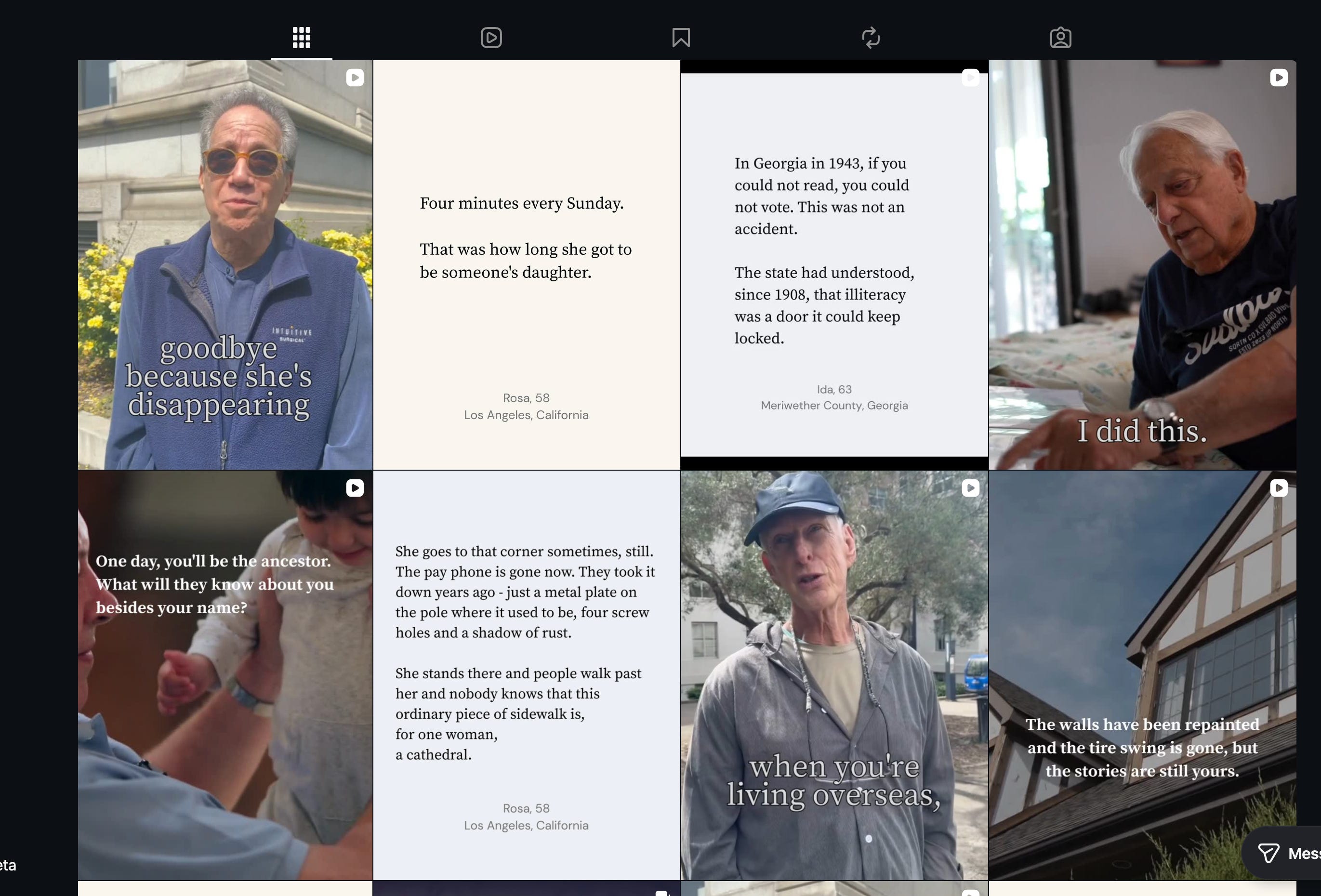
so far we’ve been taking a more organic approach as opposed to more of direct CTA/product demo strategy, or a founder-led approach. we’ve been able to attribute 1 user signup (but not retained) as coming from instagram.
what the people have been telling us
while we have a small sample size of absolute users who’ve signed up for our app (~100), i’ve had 7 user feedback calls with users who are not direct friends or family members (3 in person, 4 over google meets), and 1 general advice call with a pretty famous woman who operates a bookstore in korea and was a former marketing executive at Samsung/Cheil in Korea for over 20 years. i figured it’d be a good call to pitch the idea and get feedback since 1. she’s a literary person (and our app is a product that creates literary content with AI) 2. she’s had deep experience in marketing, and 3. she’s a business owner (and operates a related subscription-based book club).
i’ll start with the 3 things she left me with after mostly asking questions and listening, which i appreciated:
the most important thing is to articulate with conviction ‘why [the business] exists’. she told me that the first thing a visitor sees when they enter her bookstore is a huge bulletin board that states in the center the reason the bookstore exists, along with her own writing in smaller post-its around this center reason that have been her articulating other reasons - reminders to herself really - as to why her bookstore exists. she said that it helped her get through difficult times and survive other competitors who had less of a force of conviction to justify their own existence.
since the app is an AI app, it’s important to think about what the app can do that chatGPT and gemini can’t. she had asked me about our revenue model, and i had told her we planed to charge a subscription. in light of this, her point was that we had to justify the price with clear differentiation.
the app needs to be simpler and more fun. this was most surprising for me to hear, given that i had come into demoing the product to her with the assumption that as some famous literary figure in Korea who is presumably a serious highbrow person, she would appreciate how painstakingly we crafted the features to generate literary output and tuned the models. she specifically brought up that users of apps like to brag. “look at this poem i made”. and that the app needed to provide users with a way to make it easy for them to brag.
the other feedback calls
the most common pattern of feedback we get is this:
user: “the concept how is so lovely concept!” “the app is beautiful”. “my mom recently passed away and i think about how this could have been useful.” “i tried the conversation and it was a neat experience.”
us: “thank you, we really appreciate it! how many conversations have you tried?”
user: “oh, just one, just for onboarding.”
us: “ah i see. why is that?”
user: “i was just super busy these past few weeks. i promise i’ll try it again soon!”
us: “we appreciate that. what’d you think about our story generation feature?”
user: “what’s that?”
us: “oh, so after you complete a memory, you can generate memoirs, poems in different styles from it.”
user: “oh neat, i didn’t know that.”
us: “would you be interested in inviting your parents to try the app out?”
user: “mm i can ask, but honestly they’re not the most tech savvy people so it’s unlikely…”
us: “well we really appreciate your time! definitely try using the app sometime and let us know your thoughts.”
my takeaway from these calls is this: the general idea of creating an app to record and preserve family memories is lovely and quite agreeable. but that statement carries a similar energy as recycling plastic to preserve our precious earth. both are lovely and quite agreeable. but a hot app that statement alone does not make.
revisiting our initial “magic moments” theses
i’m going to provide the rebuttal to our initial magic moments (hindsight is obviously 20/20, and my rebuttals may not even be correct), but it’s a helpful exercise for me in processing why users weren’t feeling enough “magic” to return.
warm, engaging voice agent. what if it turns out that betting that a voice agent being warm and engaging is the reason it’s magical for a user is like betting on a warm, polite kind man to bring a woman to her magic orgasm in bed? as in - i’m sure some people, male or female, find nice people sexy and can get off just from that. but maybe it’s not enough. maybe there needs to be an edge. or the person needs to feel like a hero all night and the center of attention. more on this later.
immersive “topics”. yikes. even reading that original statement feels so half baked. we use the word “immersive” but there’s nothing in the subsequent clarifications that suggests why the topics are immersive. unless the fact that the topics are sequential, or about work, or about lessons, are immersive…? looking back, there just wasn’t much deep thought put into the concept of immersive. and therefore, this one felt doomed to fail. in fairness, we did spent a lot of time writing up custom prompts per topic and brainstormed them, but now that i’ve had some time to listen to podcasts (arguably the richest source/inspirational material for good immersive conversations in today’s era), it’s clear there a lot of opportunities for deeper, funnier, or edgier conversations.
“Building” flow. People naturally crave the feeling of ‘creating’ or ‘improving’. This one… definitely a few thoughts. First, I don’t think it’s a universal sentiment that people naturally crave the feeling to ‘create’ or ‘improve’. In fact, I would argue that people naturally crave consumption (of food, of social media content), but the urge to create may actually be limited to a much smaller subset of people. Now what I know personally (as someone who does actually crave creating (apps, writing, ideas, companies, doesn’t matter)) - is that when ‘creating’, or ‘improving’, what I’m really in love with is the process. The iteration, the dead ends, the exploration, the discovery, the pain, the frustration - I love it all. That process is what provides my brain with the stimulation, and the experience through which I learn. Put another way, for me, to create is to not take shortcuts. It’s to overanalyze everything. It’s to force myself to be an observer, to go on social media to study content, to go to cafes to find moments of inspiration, to read, to download apps I’d otherwise never download just to develop a tactile feel and intuition. To articulate what I like about something - to develop taste. To return back to the original planning docs months after we wrote them to learn and reflect. Yet, we designed an app that lets users generate stories with the click of a button, in many ways bypassing the process.
so in retrospect, how would i self assess how we decided on our 3 magic moments?
on the first point of view, we were wrong, but at least the point of view was well articulated.
on the second point of view - and in fairness, we do have a separate thought piece specifically focused on topics that’s reasonably thoughtful, but that notwithstanding - we definitely could have articulated/thought a bit more about the concept of what makes something ‘immersive’ (and presumably, therefore, ‘engaging’, that instagram euphemism for ‘addicting’ lol
the third point of view was by far our weakness, and the actual product decisions and workflows feels almost antithetical to how (at least for me personally) I think about what a true “creating” experience feels like? (hint: needs a lot more knobs and levers)
where does that leave us? looking ahead
¯\_(ツ)_/¯ that’s life. we learn and make the next iteration better. we’re still committed to creating magical experiences with AI with the goal of preserving and sharing stories.
in my next article, i’m talk more about the direction we’ll be exploring taking the next iteration of ember (hint: it has to do with podcasts, and the user as a hero). i’ll also be unpacking the observations i made after spending time deep in the world of user generated content across channels like instagram, tiktok, and spotify!